Hao Rust Driver ($150.00) is a 60's Marshall Plexi simulator in a box built by a japanese company... I's a good, practice and simple circuit with few controls...
HAO Rust Driver
"The HAO Rust Driver recreates the classic sound of a late 60's Marshall Plexi running at full bore grind. The HAO Rust Driver's carefully selected components perform faithfully with any amplifier at any volume. The result is a commanding tone with a tight, thick bottom and extremely low signal to noise ratio. A single knob controls output level and gain while three switchable EQ curves maximize tonal options without compromising your guitar sound. When you want that "Plexi Sound," the Rust Driver is an affordable, reliable, portable alternative to the real thing."
Below there is my Hao Rust Driver pcb layout with millenium 4049. You can try use another caps in the toggle switch if you dont like the way of these caps sound... you can also use a pot for tone insted of a switch... and I don't know which is the original IC, but any dual opamp works ok, then you can test and use one that fits your taste ....people tried use one potentiometer for gain control but this change was not good cause the pedal dont sounds plexi like if you change the gain amount... so i think is better do like the original...
Project originally developed by Menatone since 1996, the Red Snapper (sold by $179,00) is an overdrive/booster pedal derived from modifications in the basic scheme of Tube Screamer. Tube Screamer is one of the most famous overdrives and also the most cloned of all the world, it is characterized by have higher compression and mid hump. But this emphasis on mid frequency is somewhat unpleasant for the most of listeners who prefer a flat equalization...
And that's what the Menatone did, they changed the circuit of Tube Screamer to maintain the purity of the sound, without over compression and with no increase in the mids... and as a result created a pedal really good!
And how in this world everything is copied, Clark Amplification, famous for making replicas of amplifiers, decided to copy the circuit of the Red Snapper and rename it as Gainster (sold by $ 380.00) ... and how the world is not fair, Gainster ended up with more notoriety than the Red Snapper... and the 'brand' Gainster was loaned to Barber that produced the Gainster for a wile (sold for $139.95), but soon the production rights were "confiscated" by Clark Amplification.
Respectively,the pedals produced byMenatone, Clark (withahugebox) andBarber
The both pedalsbuiltbyClark andMenatonewere made byconnectingpoint-to-point,on the other hand those produced byBarberworeprinted circuit board. TheIC'susedseem tobe variation... they use JRC4558, TL072, LF353...IntheBarberpedalswas addedaninternaltrimpot as an additionaladjustment for bass frequency, this trimpotwas exteriorizedin the latestMenatone's pedalswiththe "hicut"control...
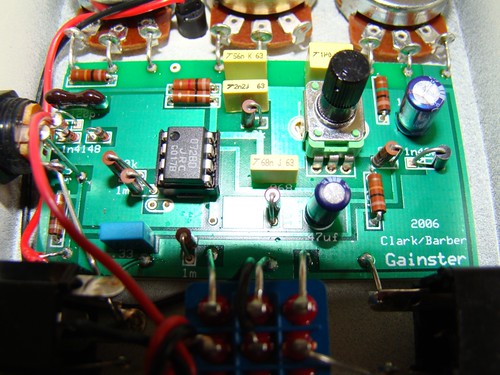
A friend of mine bought one Barber Gainster recently, and it uses the JRC072 as IC, and there are some changes like add a protection against polarity inversion in the supply path, and different values on the input and output capacitors (both 100n in Clark's circuit and they became 330n, 68n) and in the tone capacitor (47n in the clark's and56n in Barber's).
2006's Barber Gainster with some changes from the original Clark Gainster
Comparing Barber Gainster with my clone (that is a clone based on the original Clark Gainster) I notice that my clone have a few more gain... is more drive like and the Barber is more booster like... although I prefer mine... if you like the Barber's sound is just change the capacitor by those that I said above.
Here there is a comparison made with a very low sound quality camera
I renamedmy versionasHipster, I used the LF352, and the circuit ofmilleniun4049, I preferred toleave thebass control as a trimpot, aswell astheBarber version. The finish wasthe sameofmyPeachFuzz clone, in the graphics I decidedto keep the sameideaof the Gainster.